
Psychedelic-Assisted Therapy Research
Dr. Peacock’s research is in the emerging field of psychedelic-assisted therapy. His dissertation reviewed the research on eight psychedelic medicines and asked when one should be used over another for a given patient. Drawing on more than 1,100 references across the foundational and applied literature, it produced a new method for planning psychedelic treatment, which he continues to develop. You can read the dissertation and his recent presentations below, and his CV lists his full research background, publications, and presentations. He’s happy to answer questions about his work.
Consultation and expert testimony: Dr. Peacock provides consultation and expert testimony on the psychedelic therapy literature. Contact us or book a free consultation to learn more.
Applications of Psychedelic-Assisted Psychotherapy Across Personalities and Psychopathologies: An Integrative Literature Review with Meta-Analysis (Dissertation)
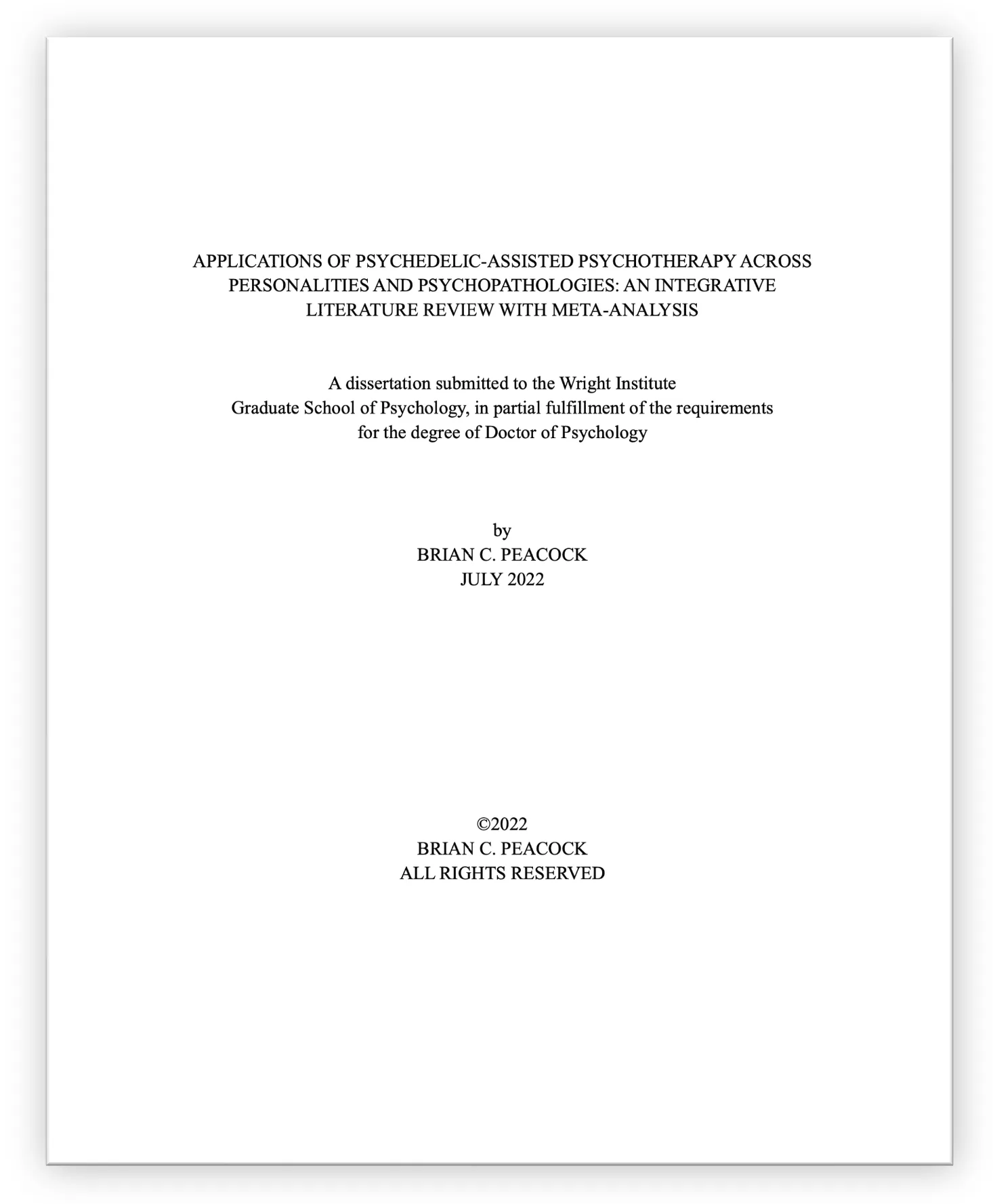
*Includes bookmarks for easy navigation with a PDF viewer.
Abstract: Psychedelic-assisted psychotherapy is reemerging in clinical practice following promising results from clinical trials for disorders such as major depression, PTSD, and death anxiety. There are many factors to consider in deciding whether a psychedelic-assisted treatment is appropriate for a patient, especially when their presentation does not fit a single diagnostic label. This study provides a practical heuristic for planning psychedelic-assisted treatments. A translational research approach was taken. Basic (T1) research in pharmacology, neuroscience, phenomenology, and psychological change were reviewed. These findings were then synthesized with applied (T2) literature regarding risks, therapy techniques, and clinical research. A systematic literature search was performed using 128 topic keywords covering topics across these literature domains. These keywords were searched in combination with the names of eight major psychedelics—mescaline, LSD, psilocybin, DMT, ayahuasca, MDMA, ketamine, and ibogaine—for a total of 1,024 separate Google Scholar searches. From this search, 1,164 references were included in this review. A preliminary meta-analysis was performed to normalize effect sizes across treatments for comparison. Findings were synthesized into summary tables to represent the literature, allow for comparison of psychedelics, and serve as clinical references. From this, a process was developed for planning evidence-based psychedelic-assisted treatments to maximize treatment efficacy while minimizing risk. Translational insights emerged, including new treatment opportunities, patient assessment criteria, and directions for future research. Finally, this study substantiates the need for legal reform to allow medical access to an expanded range of psychedelic medicines due to their unique and valuable properties.
Psychedelic Treatment Planning: Opportunities in Integrated Care
Presentation for the University of Colorado School of Medicine, Psychedelic and Experiential Medicine Interest Group, 2023
This presentation provides an overview of Dr. Peacock’s research on psychedelic treatment planning and examines its practical applications in larger healthcare systems such as Denver Health. Slides detail the method of psychedelic treatment planning described in his dissertation, the legal state of psychedelic medicine in 2023 Colorado, a hypothetical treatment center model, and his dissertation findings regarding specific psychedelics in clinical practice. It also covers pragmatic considerations of psychedelic treatment in managed healthcare systems including costs, insurance reimbursement, and liability management.
Psychedelic Interventions for Neuropsychological Conditions: A Call for Further Study
Poster presented at the National Academy of Neuropsychology (NAN) 44th Annual Conference, 2022
Objective: Psychedelic-assisted therapies are emerging as safe and effective treatments for some psychological conditions including depression, anxiety, posttraumatic stress disorder, and substance use disorders. As ketamine therapy is already available in general medicine and 3,4 Methylenedioxymethamphetamine (MDMA) and psilocybin are in late-stage clinical trials, neuropsychologists should be aware of these therapy options. The goal of this study was to identify new targets for psychedelic intervention and to evaluate the applicability and contraindications of psychedelic therapies in those with neuropsychological conditions.
Data Selection: A systematic literature search was performed using 128 topic keywords covering topics related to psychedelic pharmacology, risk, neuroscience, neuropsychology, psychological change, and clinical applications. These keywords were searched in combination with names of eight major psychedelics for a total of 1,024 separate Google Scholar searches. This yielded 4,319 papers with over eight hundred included based on translational relevance.
Data Synthesis: Data were synthesized using a translational approach, with findings building from basic research to clinical application. Literature was summarized into tables comparing sample, technique, statistical confidence, and effect size (computed when not available). Critical analysis was performed to evaluate the literature and generate new clinical insights.
Conclusion: Emerging opportunities for psychedelic therapies to treat neuropsychological conditions, including traumatic brain injury, cerebrovascular accident, autism spectrum disorder, and attention-deficit/hyperactivity disorder were identified. Some contraindications were also found to psychedelic treatment of psychological disorders that co-occur with neuropsychological conditions. These findings are contextualized with the current state of psychedelic medicine to support practitioners in providing actionable clinical recommendations.
Not sure where to start?
A free consultation is a short conversation about your questions and which of our services fits.